int ***values;Sunday, December 6, 2009

Thursday, November 19, 2009

Tuesday, October 27, 2009
FYP Presentaion
Wednesday 21st of October, on a cold wet morning 6 student were slowly roast, much to the joy of the 3 baying lecturers.
I'm exaggerating, but nobody got out of the presentation without a solid attack on there project.


Here is a copy of my slides:
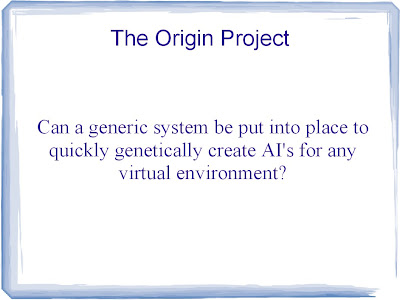


Some of the best questions I was ask at the end are;
How is this different from the traditional GP paradigm?
Why are you using genetic programming?
What sort if API's do your virtual environment's have?
I won't answer these now but they will leak out eventually.
I won't answer these now but they will leak out eventually.
Friday, October 23, 2009
Updated timetable
This is the updated timetable.
Milestone 1 Deciding and coding of the XML format 31st Oct
Milestone 2 Programming of Genetic logic 28th Nov
Milestone 3 First working entity 25th Dec
Milestone 4 Second working VE 17th Jan
Incremental addition of more VE's as time permits
Those of you paying attention will notice that the distributed part of the project has been dropped. Time is the main reason for this tho I hope to re-include it again before the end.
There will be a post regarding my presentation up soon.............
Milestone 1 Deciding and coding of the XML format 31st Oct
Milestone 2 Programming of Genetic logic 28th Nov
Milestone 3 First working entity 25th Dec
Milestone 4 Second working VE 17th Jan
Incremental addition of more VE's as time permits
Those of you paying attention will notice that the distributed part of the project has been dropped. Time is the main reason for this tho I hope to re-include it again before the end.
There will be a post regarding my presentation up soon.............
Monday, October 12, 2009
Monday, October 5, 2009
Timeline Change
I have started working on the ml first. This is because, while the distrubited aspect is not critical to making a prototype, the markup language is.
Expect a post with the update time table soon.
Expect a post with the update time table soon.
Friday, October 2, 2009
Forum Transcript
This is of little project value but I found it humours. These are the people I go to for /prog/ramming help.
C# vs C++
1 Name: Anonymous : 2009-10-01 16:56
I'm not looking to start some sort of fanboy arguement.
Is the ease in development brought by C# worth more than the power/speed of C++?
I'm writing a genetic algorithim so speed is pretty important.
I can't find any legit benchmark test so I'm lookin for oppinions here.
2 Name: Anonymous : 2009-10-01 17:00
OMG PONIES
3 Name: Anonymous : 2009-10-01 17:01
I'm not looking to start some sort of fanboy arguement.
Now you have 2 problems.
4 Name: Anonymous : 2009-10-01 17:05
Who the fuck even uses C# ? Just use sepples.
5 Name: Anonymous : 2009-10-01 17:09
On behalf of C#, I have to say, that LINQ thing looks pretty interesting. But I never used it, so what the fuck do I know?
6 Name: Anonymous : 2009-10-01 17:15
>>1
Is the ease in development brought by C# worth more than the power/speed of C++?
C++ has no power or speed. However, in reality, ease of development trumps both of those most of the time anyway.
But for a genetic algorithm, use C. Preferably C calls from a Foreign Function Interface of a higher level language.
7 Name: Anonymous : 2009-10-01 17:19
C# is only good if you want to make money
8 Name: Anonymous : 2009-10-01 17:35
>>5
I have used LINQ and can tell you it's fucking amazing. Being able to write queries directly in the language is a major advantage, and that LINQ works against many different types of things (objects, XML, SQL, Entities, etc.) is even better.
9 Name: Anonymous : 2009-10-01 18:16
>>8
Does it gain you all that much over list expressions when you're not dealing with SQL? I haven't seen many compelling examples.
10 Name: Anonymous : 2009-10-01 19:04
>>1
Sepples is only worthwhile for things that absolutely need the performance and would benefit from the features of Sepples, e.g. inheritance.
Games are a specific problem domain that work decently with Sepples, but that's about it. Outside of gaming, there really isn't much use in Sepples.
Almost all other languages do other functions better, e.g. C for device drivers, C#, D, Delphi, etc. for userspace, and so on.
Thursday, October 1, 2009
Genetic Logic
What do I need this part of the system to do?
This part is where the guts of the work will take place. I need a system that can interpret my markup language and apply generational logic to it. A mutation system and a way remove the least fit from every generation.
How will it do this?
There are a few(read thousands) libraries out there for genetic algorithms. I have not decided which one I will be using, or if i will be making my own.
Further reading
http://lancet.mit.edu/ga/
http://citeseerx.ist.psu.edu/viewdoc/download?doi=10.1.1.19.1906&rep=rep1&type=pdf
This part is where the guts of the work will take place. I need a system that can interpret my markup language and apply generational logic to it. A mutation system and a way remove the least fit from every generation.
How will it do this?
There are a few(read thousands) libraries out there for genetic algorithms. I have not decided which one I will be using, or if i will be making my own.
Further reading
http://lancet.mit.edu/ga/
http://citeseerx.ist.psu.edu/viewdoc/download?doi=10.1.1.19.1906&rep=rep1&type=pdf
Monday, September 28, 2009
Markup Language
What do I need this part of the system to do?
This part is needed to force the user to translate there language into a format that my genetic logic can deal with, need to be broad enough to be able to cover most/all modern languages, needs to be easy enough to learn, needs to be efficient so that there isn't a gigantic overhead
How will it do this?
I will be creating my own style markup language. The exact style has yet to be decided. With a combination of several levels and termination sets it should work well with the genetic logic.
This is NOT a compiler, tho I will be reading compiler books and papers as the natural language processing is similar.
Further reading
Aho, A. V., Lam, M. S., Sethi, R., & Ullman, J. D. ('2006'). Compilers - Principles, Techniques and Tools.
This part is needed to force the user to translate there language into a format that my genetic logic can deal with, need to be broad enough to be able to cover most/all modern languages, needs to be easy enough to learn, needs to be efficient so that there isn't a gigantic overhead
How will it do this?
I will be creating my own style markup language. The exact style has yet to be decided. With a combination of several levels and termination sets it should work well with the genetic logic.
This is NOT a compiler, tho I will be reading compiler books and papers as the natural language processing is similar.
Further reading
Aho, A. V., Lam, M. S., Sethi, R., & Ullman, J. D. ('2006'). Compilers - Principles, Techniques and Tools.
Sunday, September 27, 2009
Distributed System
What do I need this part of the system to do?
Pass out the files containing all information that a system will need to run the VE and genetic algorithm. Return a log file to the master machine. Run checks to insure the others machines are accessible and how far along they are in there current generation.
How will it do this?
A simple combination of messages and acknowledgments will do for the running checks bit. FTP protocols will be used to send the Files across.
A separate tread will be need to listen for calls so that ongoing work will not be effected.
Further reading
www.code.google.com/edu/parallel/dsd-tutorial.html
Book: Optimization using distributed genetic algorithms
ISBN: 978-3-540-54148-6
Publisher: Springer Berlin / Heidelberg
Pass out the files containing all information that a system will need to run the VE and genetic algorithm. Return a log file to the master machine. Run checks to insure the others machines are accessible and how far along they are in there current generation.
How will it do this?
A simple combination of messages and acknowledgments will do for the running checks bit. FTP protocols will be used to send the Files across.
A separate tread will be need to listen for calls so that ongoing work will not be effected.
Further reading
www.code.google.com/edu/parallel/dsd-tutorial.html
Book: Optimization using distributed genetic algorithms
ISBN: 978-3-540-54148-6
Publisher: Springer Berlin / Heidelberg
Subscribe to:
Posts (Atom)